
Test scope, screenshots, checkpoint findings and tier rationale were supplied by an identified reviewer. Identity is retained internally unless public attribution is explicitly enabled.

AI · South AfricaFull evidence record
Hut Beatz
Hut Beatz presents an AI media-generation and creator marketplace experience for generating and sharing or selling music and other digital content.
Sandbox Africa checked the submitted evidence and promoted the verified checkpoint record. Any visible adjustment is identified rather than silently rewritten.
The official public tier and technical record below are the verified publication outcome.
Tier 0 — Concept / Vaporware
Keep Tier 0. Account creation works, but the defining product function did not produce output under any tested condition and multiple backend-backed surfaces failed.
Strongest supporting evidence
The core product function — AI content generation — failed on all three independently tested attempts, across two account states (logged out and logged in), with two distinct error types (HTTP 402 Payment Required; "Invalid or expired token"), ruling out a simple one-off fault. The same underlying reliability problem recurred on two unrelated features: the Explore/community page and the account dashboard both independently returned "Failed to load public tracks," and dashboard usage statistics never resolved past a loading state. The advertised API Documentation link leads nowhere. Registration and site presentation are polished, but the product does not perform its central claimed workflow under any tested condition.
Why the next tier is not yet supported
Tier 1 requires the core loop to work, even if unpolished. It does not — generation failed on every attempt, with no successful output produced under any tested condition, including while authenticated. This is not an interface or scalability shortfall, which would be consistent with Tier 1; it is a complete failure of the platform's only functional purpose. The recurring backend error across unrelated features (community feed, dashboard statistics) further indicates a systemic reliability problem rather than an isolated bug in one feature, reinforcing that the core product cannot currently be relied upon to perform its function at all.
Verified findings and limitations
Direct review observations
The intern successfully registered and reached an authenticated dashboard, but three AI generation attempts across logged-out and logged-in states failed. Public-track loading and dashboard statistics also returned persistent errors.
Independent verification
The current public site remains online, but site availability alone does not resolve the directly observed failures of the core generation workflow.
Observed issues
Core generation failed with HTTP 402 or token errors; public-track feeds failed; usage statistics did not resolve; the advertised API documentation link did not provide usable documentation.
Testing limitations
A paid plan was not purchased, so it was not possible to determine whether one error was plan gating; however, multiple unrelated backend failures remained present while authenticated.
Independent verification sources. Source 1
What was actually assessed
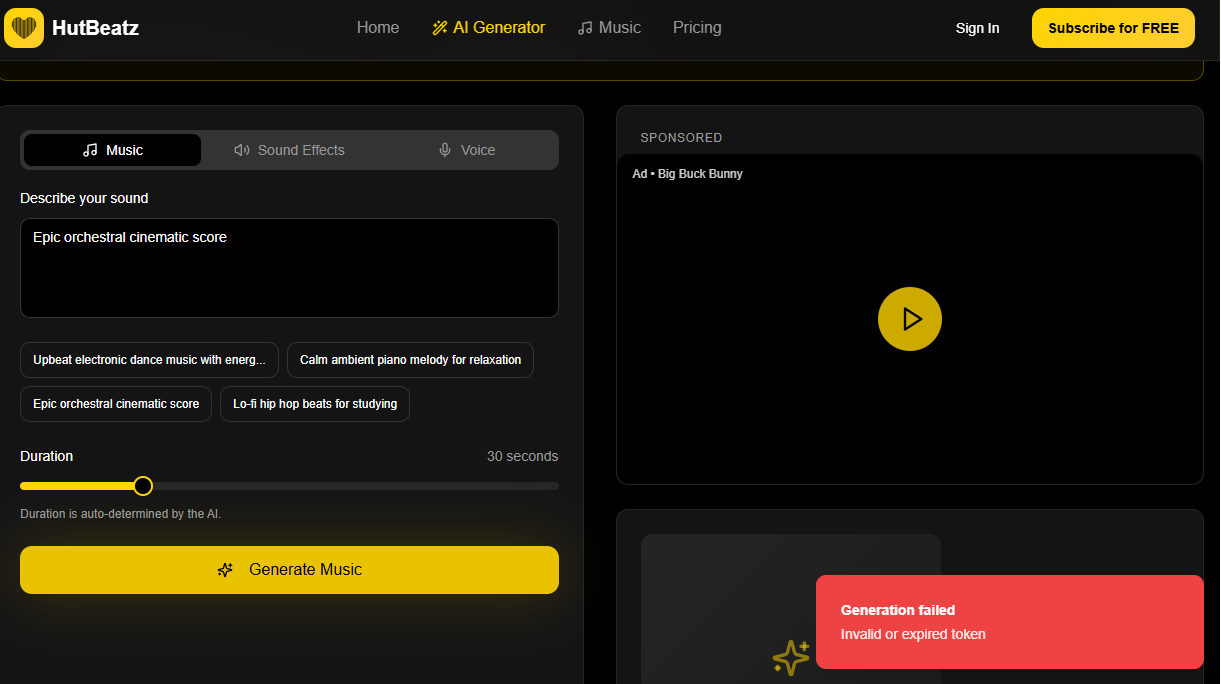
Loaded hutbeatz.com and reviewed site structure and navigation across all main pages, confirming no dead links or load faults on the marketing surface. Searched f6s independently to confirm South African origin and cross-check the platform's own description of its product, since generation and marketplace functionality were not immediately obvious from the homepage alone. Attempted AI music generation while logged out, first with a custom prompt, which returned HTTP 402 (Payment Required), then with a suggested prompt chip, which returned a different error, "Invalid or expired token." Registered for an account and signed in successfully, reaching an authenticated dashboard, then attempted generation again while logged in to isolate whether the failures were authentication-related; generation still did not succeed. Visited the Explore/community page and observed a "Failed to load public tracks" error, then returned to the dashboard and observed the same error recurring alongside usage statistics stuck on a loading state. Located and clicked the "API Documentation" link, which did not lead to any content. Checked the site's TLS certificate directly via browser inspection to confirm HTTPS configuration. Searched the footer and standard page locations for a privacy policy or terms of service; none was found.
Environment / device / browser
Edge on Windows
Account or access type
Personal
Access limitations
Core generation functionality could not be tested successfully, as all three attempts (across two account states) returned errors rather than output — it remains unclear whether a paid plan would resolve this, since the free-tier failure mode (402 Payment Required) suggests a payment gate, while the second failure mode ("Invalid or expired token") suggests a technical fault unrelated to plan tier. This distinction could not be isolated without a paid account, which was not tested. The API Documentation link leads nowhere, so integration capability could not be assessed beyond confirming the link itself is non-functional. No privacy policy, terms of service, or content ownership statement could be located, so this analyst cannot confirm whether one exists but is simply not linked from the pages reviewed, or does not exist at all. No second account or role (e.g. buyer-side marketplace experience) was tested, so the sales/purchase side of the platform is entirely unassessed.
What was observed
These images formed part of the evidence pack considered during verification. Full-standard records retain the contributor's factual caption for each screenshot.
Evidence 1
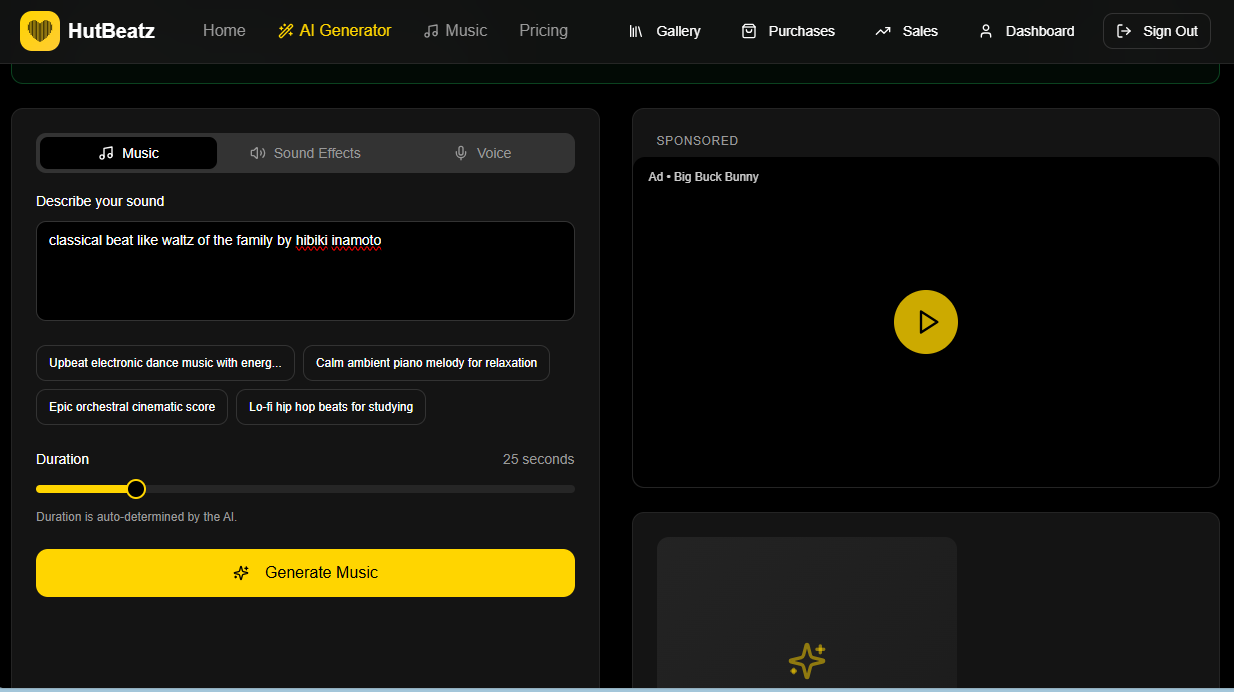
Authenticated dashboard Account dashboard after successful registration and sign-in, confirming onboarding functions correctly.
Evidence 2
Generation attempt, logged out Second generation attempt, using a suggested prompt chip while logged out. Returned a different error from the first attempt — "Generation failed: Invalid or expired token" — indicating a distinct failure mode rather than a repeat of the same fault.
Evidence 3
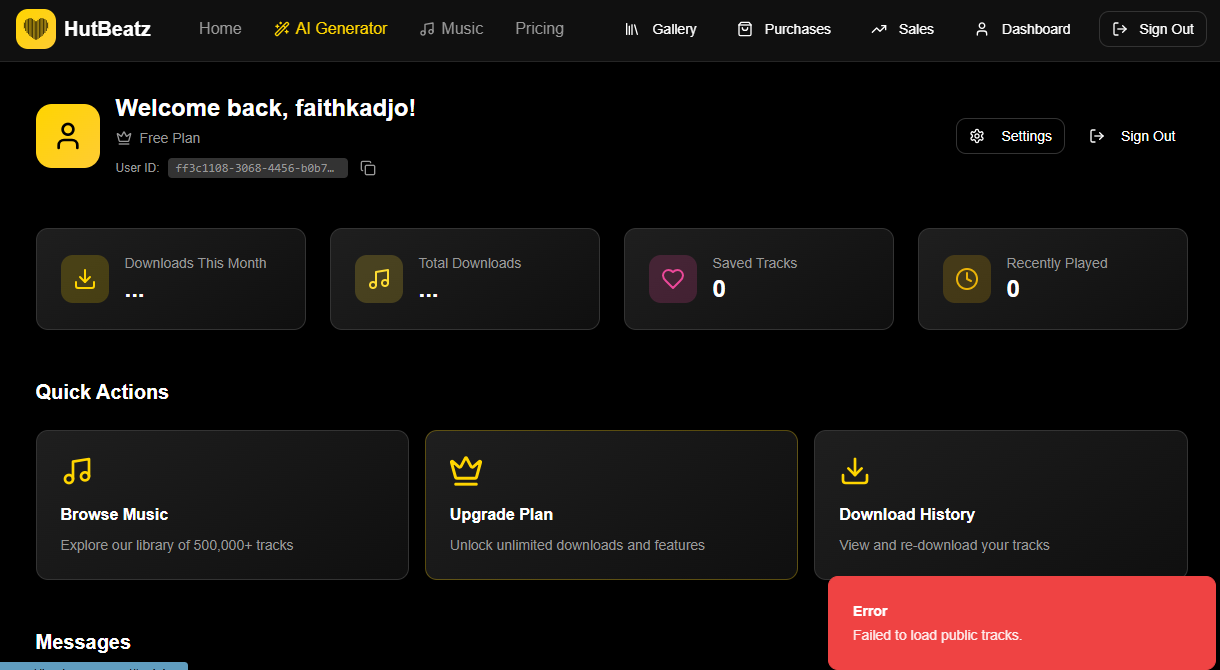
Generation attempt AI Generator interface showing a custom prompt submitted for music generation. This attempt returned HTTP 402 (Payment Required), the first of three failed generation attempts recorded during testing.
Evidence 4
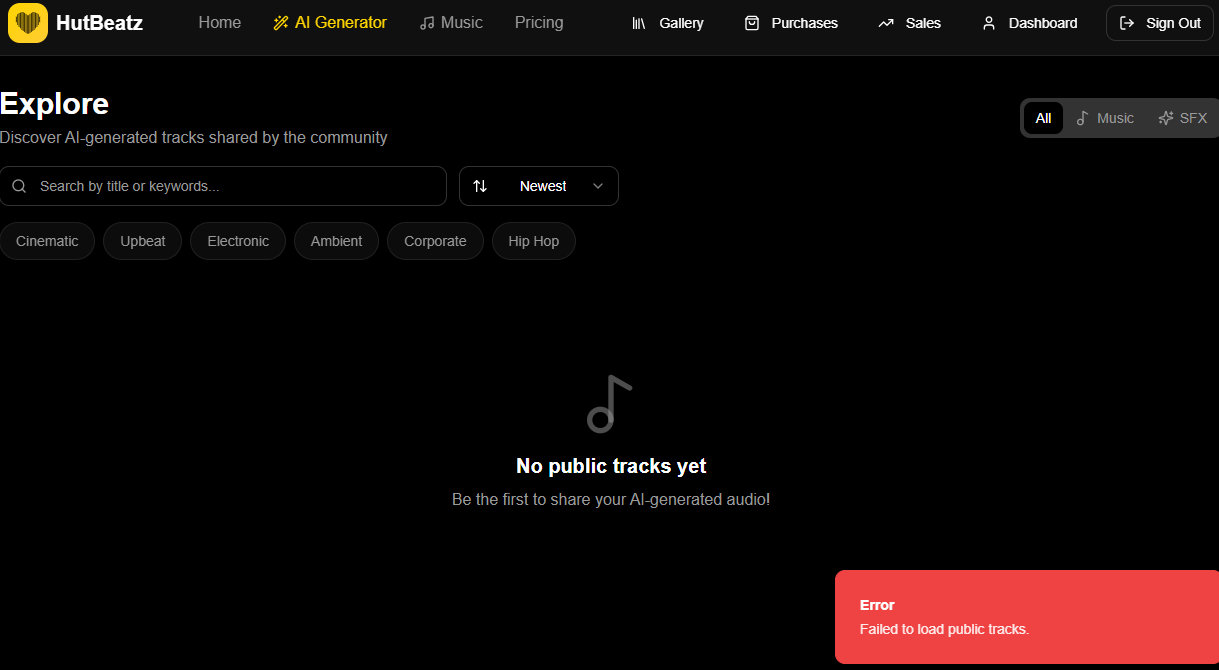
Explore page error The Explore/community page simultaneously displays "No public tracks yet" and "Error — Failed to load public tracks." These two messages are inconsistent, since a failed data load cannot also confirm zero tracks exist — evidence of a backend loading fault presented as an empty state.
Seven checkpoint assessment
The verified result is the official public checkpoint record. For earlier-standard reviews, these findings may have been reconstructed from preserved evidence during Sandbox Africa’s 2026 audit; they are not presented as if the contributor originally completed a structured worksheet. Contributor-submitted checkpoint wording is shown only where explicit public reviewer attribution has been enabled.
Step 1 — The Existence & Accessibility Check
Is it live?
Checking for dead links, infinite loading screens, or "Coming Soon" landing pages masquerading as live products.
Sandbox verifiedpass
Site loads fully, with a working navigation bar (Home, AI Generator, Music, Pricing, Gallery, Purchases, Sales, Dashboard) and no dead links or infinite loading observed. A functioning, structured product, not a placeholder.
Onboarding friction
Can a user or enterprise actually sign up, or is it gated behind broken "Contact Sales" forms?
Sandbox verifiedpass
Registration and sign-in were completed successfully, reaching the account dashboard. Onboarding itself functioned without issue — the failure occurs downstream, at the generation step, not at account creation.
Step 2 — Functional Testing (The "Try It Out" Phase)
Core loop execution
Does the application actually do what it claims to do? (e.g. a payment gateway completing a test transaction, a logistics app's routing engine working.)
Sandbox verifiedfail
Three generation attempts were made across two account states, all unsuccessful. Anonymous attempts returned HTTP 402 (Payment Required) and separately "Invalid or expired token." After completing registration and sign-in, a further attempt still failed to generate. Since generation failed both while logged out and while logged in, the block does not appear to depend on authentication status — it is more likely a payment, credit, or platform-side fault affecting all users. The platform's single core function could not be completed under any tested condition.
User experience (UX) & interface (UI)
Assessing the logical flow, responsiveness, and basic accessibility of the platform.
Sandbox verifiedpartial
The interface itself is logically laid out — clear category tabs (Music/Sound Effects/Voice), suggested prompt chips, a visible duration control, and a clean account dashboard reachable after sign-in. Responsiveness on the pages tested was smooth, with no rendering faults. Error handling, however, is weak. The Explore page displayed two contradictory messages simultaneously — "No public tracks yet" and "Failed to load public tracks" — which cannot both be true and would confuse a user about whether the platform genuinely has no content or is simply broken. Generation failures returned technical, user-unfriendly messages ("Invalid or expired token") with no explanation or next step offered. The API Documentation link is present in the navigation but does not lead to any content, silently returning the user to the homepage rather than showing an error or a "coming soon" state — a broken link disguised as a working one. Header state was also inconsistent across sessions, showing "Sign Out" in one screenshot and "Sign In / Subscribe for FREE" in another under what should have been comparable conditions. Basic accessibility (contrast, labelling, keyboard navigation) was not specifically tested within this assessment's scope.
Step 3 — Technical & Architectural Assessment
Performance
Load speeds, uptime reliability, and basic stress responses.
Sandbox verifiedfail
The same "Failed to load public tracks" error recurred independently on two separate pages — the Explore/community feed and the authenticated Dashboard. Dashboard usage statistics (Downloads This Month, Total Downloads) remained stuck on a loading indicator with no resolution. This indicates a backend or data-loading fault affecting multiple features, not an isolated issue confined to AI generation
Integration readiness
Availability, clarity, and functionality of API documentation and webhooks.
Sandbox verifiedfail
An "API Documentation" link exists in the site's footer or navigation, but clicking it does not lead to any actual documentation — the page simply scrolls back up to the homepage. This is a dead reference masquerading as a real link, not a missing feature the platform is honest about lacking. It is a sharper finding than "no API exists," because it means the platform actively advertises programmatic access that isn't there.
Security basics
SSL certification, basic encryption standards, and data handling transparency.
Sandbox verifiedpartial
HTTPS confirmed via a valid certificate for hutbeatz.com, issued by Google Trust Services, issued 22 June 2026, expiring 20 September 2026 — standard transport security, correctly configured. Registration and authentication
Company right of reply
Claim company profile
Represent Hut Beatz?
Claiming verifies company ownership and enables a response or additional evidence. It does not permit editing of the independent review.